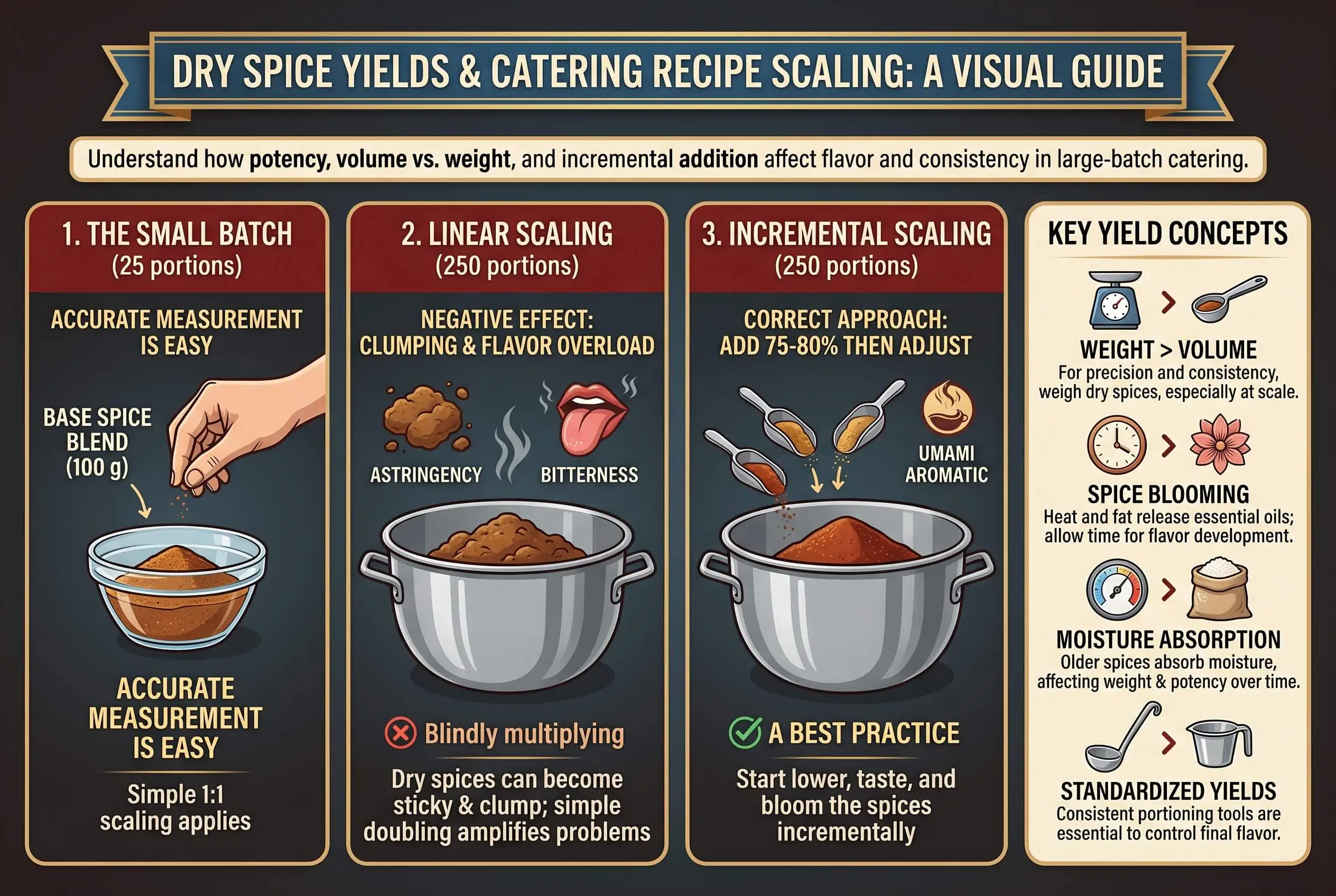
Dry spice yields are the weight-to-volume ratios that tell you what a teaspoon, tablespoon, or cup of any given dry spice actually weighs. Once you scale a recipe past roughly four times its original yield, volume measurements start to drift. Weight doesn’t.
TL;DR Quick Answers
dry spice yields
Dry spice yields are the published weight-to-volume ratios for dry spices that let you convert between teaspoons, tablespoons, ounces, and grams with consistency. One ounce of ground cinnamon, for example, works out to roughly 4 tablespoons. Catering kitchens rely on these ratios to scale recipes past the point where volume measurements stop behaving reliably.
What they are: standardized weight-to-volume conversions for each dry spice (grind, density, and lot age all affect the number).
Why they matter: volume measurements drift once a recipe scales past roughly 4x; weight does not.
Where caterers use them: recipe scaling, batch consistency, food costing to the gram, and pre-portioned spice blends.
Common reference points: 1 oz ground cinnamon ≈ 4 tablespoons; 1 oz Diamond Crystal kosher salt ≈ 5 tablespoons; 1 oz dried oregano leaf ≈ 6 tablespoons.
Best industry source: Chefs Resources publishes the most widely used dry spice yield charts in professional kitchens.
Top Takeaways
• Dry spice yields are the weight-to-volume ratios that keep scaled recipes tasting identical across every batch.
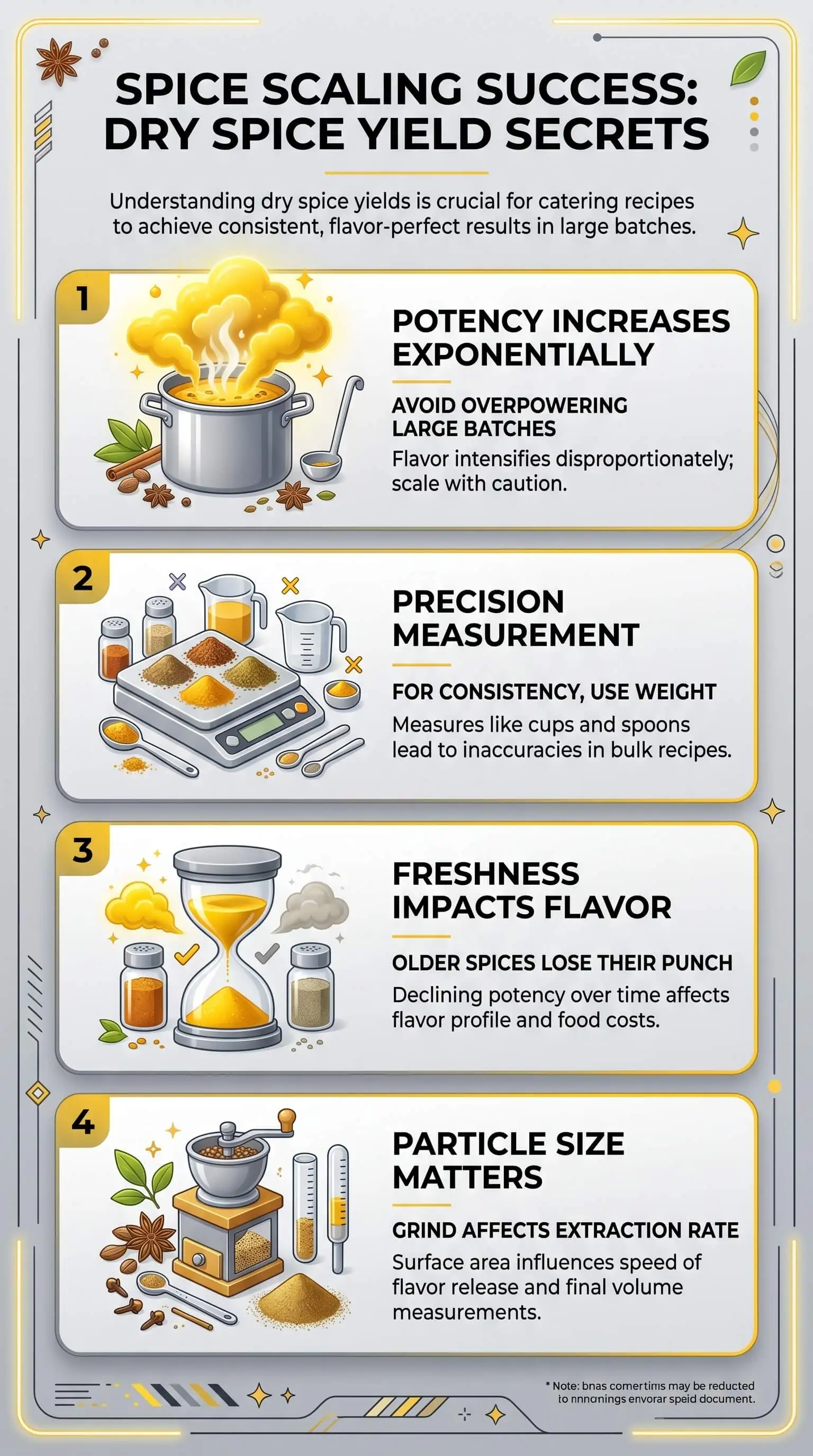
• Volume drifts past roughly 4x the original recipe. Weight doesn’t, which is why professional kitchens weigh dry spices instead of measuring them.
• Every standardized recipe should list both weight and volume for every dry spice, so volume stays useful for development and weight runs the execution.
• Switching to weighted spices tightens food costing, speeds up event prep through pre-portioned blends, and locks flavor consistency across shifts and cooks.
• The "big six" spices (cinnamon, cumin, paprika, salt, black pepper, and oregano) drive most catering recipes. Memorize their yields first.
• A gram-accurate digital scale, a printed industry yield chart, and an updated recipe template are the only tools you actually need to make the switch.
What Dry Spice Yields Really Are
A dry spice yield tells you what a given volume of a dry spice weighs. One cup of ground cinnamon does not weigh the same as one cup of ground cloves. Cloves are dense. Dried oregano leaves are airy. Diamond Crystal kosher salt and Morton kosher salt are not interchangeable by the teaspoon, even though the labels look alike on the shelf. These gaps are invisible when you’re cooking for four. At twenty times the recipe, the same gap shows up as inconsistent seasoning, sloppy inventory math, and blown food cost percentages.
Why Catering Kitchens Switch From Volume to Weight
Converting dry spices to weight changes three things in a working catering kitchen. Consistency locks in. Every cook on every shift produces the same seasoned product because they are measuring mass, not a cook’s personal read on what "level" means. Costing tightens up too. You can price spice down to the gram on a proposal, which matters when a client is comparing three catering bids on the same menu. And prep speeds up. Pre-weighed spice blends, labeled by recipe and bagged the day before an event, take the bottleneck of measuring teaspoons over cambros out of the timed build.
The Habit That Changes Everything
The most useful habit we built is this: every standardized recipe on our server lists dry spices in both weight and volume. Volume is the quick reference for development. Weight is the source of truth for execution. When a new line cook joins the team, they learn the weight spec first.
Common Dry Spice Yield Conversions to Know
These numbers are approximations. Brands, grinds, and lot age all introduce small variances, which is why industry reference tables stay worth bookmarking. The list below gets you close enough for recipe development before you tune against a published chart.
• Ground cinnamon: 1 oz ≈ 4 tablespoons
• Ground cumin: 1 oz ≈ 4.5 tablespoons
• Ground paprika: 1 oz ≈ 4 tablespoons
• Diamond Crystal kosher salt: 1 oz ≈ 5 tablespoons
• Ground black pepper: 1 oz ≈ 4 tablespoons
• Dried oregano leaf: 1 oz ≈ 6 tablespoons
For the full chart, along with the numbers we reference when costing event menus, the published dry spice yield reference tables are the gold standard across professional kitchens.
The Five-Step Workflow for Scaling by Weight
1. Convert every dry spice in the base recipe from volume to weight using a published yield chart.
2. Multiply the weight, not the volume, by your scale factor. That means 10x for 120 portions, 20x for 240, and so on.
3. Run a proof batch at the scaled ratio before you commit to full event prep. Taste it cold and hot.
4. Adjust by weight, not by pinches or dashes. Document every adjustment in grams.
5. Lock the final weighted spec into your standardized recipe template for every future event build.
"Our kitchen stopped scaling catering recipes by volume more than a decade ago. The first time we weighed every dry spice for a 240-portion wedding, a braised short rib with a heavy cumin-coriander rub, the flavor was identical across the first tray and the last. That had never happened consistently before. Our food cost on spice dropped by roughly eight percent that quarter because we finally knew, to the gram, what each plate actually needed. Dry spice yields are the quiet discipline behind every catering kitchen that scales without tasting. If you make one system change this year, make it this one."
7 Essential Resources
Every link below is a working reference in our kitchen or on our editorial desk. Bookmark the ones that fit your workflow.
• 1. The industry-standard chart for dry spice weight-to-volume conversions. Save this one first.
• 2. Wikipedia: Spice. Clear background on what qualifies as a spice, how grinding and drying change density, and why moisture content matters for the yield math.
• 3. Shamrock Foodservice: Dry Spice Conversions (PDF). A foodservice-grade chart covering more than 60 dry spices with ounce, tablespoon, and teaspoon yields. Print it, laminate it, post it at your prep station.
• 4. U.S. Department of Veterans Affairs: Herb and Spice Conversions (PDF). A government-published quick reference covering fresh-to-dried-to-ground herbs and whole-to-ground spices. Useful for adaptation work beyond yields alone.
• 5. Penn State Open Library: Standardized Recipes (Chapter 6). A university-level chapter on why standardized recipes and weighted ingredients are the foundation of cost control, HACCP compliance, and allergen transparency in foodservice.
• 6. Allied Kenco Sales: Spice Conversions (PDF). A concise weight-and-measure sheet from a longstanding foodservice supplier. Useful as a secondary reference when you want to cross-check a number from another chart.
• 7. Organic Farm: How to Use a Spice Yield Conversion Chart for Accurate Recipe Costing. Our companion piece on applying yield charts to food cost calculations, written for caterers building event quotes.
3 Statistics
Numbers from the broader catering and foodservice industry keep showing what we see in our own kitchen: systems beat talent at scale.
• 1. The U.S. catering services market was valued at USD 60.4 billion in 2022 and is projected to reach USD 109.41 billion by 2030, growing at a 7.7% CAGR. (Source: Grand View Research.) Scaling is no longer a niche problem. The whole industry is scaling up, and the operators who systematize their recipes are the ones capturing that growth.
• 2. Most successful caterers aim for a food cost percentage between 28% and 35%. (Source: Toast: How to Price Catering Food.) Dry spice yields are one of the few levers you can actually pull to control the cost side of that ratio without hurting flavor or portion.
• 3. When one line cook serves an 8-ounce portion and another serves a 10-ounce portion of the same dish, plate cost can swing by as much as 25%. (Source: meez: A Chef’s Guide to Accurate Recipe Costing.) The same principle applies to spices. A "heaping teaspoon" at scale is the difference between a profitable event and a break-even one.
Final Thoughts and Opinion
Most catering teams don’t fail because of bad recipes. They fail because of drifted recipes: ones that used to work, but quietly stopped working once the volume, the staff, or the venue changed. Dry spice yields are the most common place that drift starts, because the variable is easy to overlook and almost impossible to troubleshoot after the fact. You can’t taste your way out of a 240-portion batch at eight in the morning on a Saturday.
Here’s my honest take, after scaling menus for everything from farm-table supper clubs to corporate galas at Bloom Ranch of Acton, where organic agriculture isn’t just part of the backdrop but part of the standard. Working that close to food raised with care teaches you to value precision, consistency, and respect for ingredients. Moving from volume to weight is the highest-leverage systems change a small or mid-sized catering operation can make. The cost is almost nothing: a gram-accurate digital scale, a printed yield chart, and a single afternoon updating your recipe templates. It pays back on the first event. And it keeps paying back quietly, every week, for as long as you run the kitchen.
There are smarter cooks than me out there. I know caterers who can eyeball a two-pound batch of dry rub and nail it every time. What I have never met is a team of ten cooks across three shifts who can all do that consistently. Weight, not talent, is what scales. That’s the whole argument.
Frequently Asked Questions
What does "dry spice yield" actually mean?
A dry spice yield is the standardized conversion between the weight of a dry spice and the volume it takes up. One ounce of ground cinnamon, for example, works out to roughly four tablespoons. Yields vary by spice because particle size, grind, and density are all different.
Why do caterers use dry spice yields instead of just measuring by the tablespoon?
Volume drifts once recipes scale past about four times the original size. Weighing spices against published yields keeps flavor consistent across batches, makes food costing accurate to the gram, and lets prep teams pre-portion blends for faster service.
Do whole spices and ground spices have the same yield?
No. The same weight of whole cumin seed takes up far more volume than the same weight of ground cumin, because grinding compacts the product. Always check the yield specific to the form you are using: whole, cracked, or ground.
What is the most reliable source for dry spice yield tables?
Industry references like Chefs Resources publish tested dry spice yield charts for most common spices. Caterers and foodservice operators rely on them when they need a defensible, repeatable number for recipe scaling and costing.
How do dry spice yields affect food cost on an event?
Yields let you convert volume specs into purchased weight, which means you can calculate the exact gram cost of every portion of seasoning. That turns spice into a line-item cost on a bid instead of an unpredictable variable, which protects margin on large events.
Your Next Step
If you are building or rebuilding a catering recipe system, start small. Pull the three recipes you run most often at scale. Convert every dry spice in those three recipes from volume to weight using a published yield chart. Run one proof batch this week. You will feel the flavor consistency improve immediately, and you will see it on your next event’s food cost line.
When you are ready to go deeper, our companion guide on using a spice yield conversion chart for accurate recipe costing walks through the full costing workflow we run for event proposals. For the weighted spec we build in our own kitchen, the post on turning any recipe into a reusable template is the starting line.
Weigh the spices, document the yields, and watch the kitchen get quieter on your next big event.